Buy dümmer-see.com ?
We are moving the project
dümmer-see.com .
Are you interested in purchasing the domain
dümmer-see.com ?
domain@kv-gmbh.de · 0541-91531010
Buy dümmer-see.com ?
What is a trapezoid?
A trapezoid is a quadrilateral with at least one pair of parallel sides. The parallel sides are called the bases of the trapezoid, and the non-parallel sides are called the legs. The height of a trapezoid is the perpendicular distance between the two bases. The area of a trapezoid can be calculated using the formula A = (1/2) * (b1 + b2) * h, where b1 and b2 are the lengths of the two bases and h is the height. **
What is the difference between an isosceles trapezoid and an equilateral trapezoid?
An isosceles trapezoid has two sides that are equal in length, while an equilateral trapezoid has all four sides of equal length. In an isosceles trapezoid, the non-parallel sides are of equal length, whereas in an equilateral trapezoid, all four sides are equal. Additionally, the angles in an isosceles trapezoid may be different, while in an equilateral trapezoid, all angles are equal. **

Similar search terms for Trapezoid
Top-Angebote
Products related to Trapezoid:
-
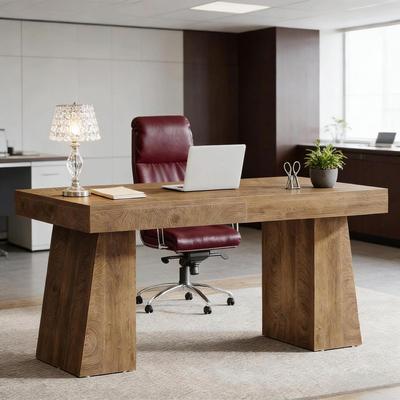
CARMORICO "55"" Mid-Century Modern Executive Desk with Trapezoid Base for Home Office"Features Mid-Century Modern Elegance: This 55-inch executive desk showcases a sleek mid-century modern design with a chic finish, adding sophistication and style to any home office, study, or professional workspace.342,49 $*Shipping: 0,00 $Secure redirect to the provider



-
What is the difference between an isosceles trapezoid and a symmetric trapezoid?
An isosceles trapezoid is a type of trapezoid where the non-parallel sides are congruent, meaning they have the same length. This results in two of the angles being equal in measure. A symmetric trapezoid, on the other hand, is a trapezoid with a line of symmetry, meaning that if the trapezoid is folded along this line, the two halves will perfectly overlap. This means that the non-parallel sides of a symmetric trapezoid are not necessarily congruent, but the trapezoid has a line of symmetry. **
-
How is parking regulated at Lake Dümmer?
Parking at Lake Dümmer is regulated through designated parking areas and parking regulations enforced by local authorities. There are specific parking lots and areas designated for visitors to park their vehicles, and parking is not allowed in certain areas to protect the natural environment. Additionally, there may be time limits or fees associated with parking in certain areas around the lake. Visitors are encouraged to follow the parking regulations to ensure the safety and preservation of the area. **
-
How can one park at Lake Dümmer?
At Lake Dümmer, there are designated parking areas for visitors. These parking areas are located near the lake and provide easy access to the recreational areas. Visitors can park their vehicles in these designated parking areas and then explore the lake and its surroundings on foot or by bike. It's important to follow the parking regulations and signs to ensure a safe and enjoyable experience for everyone. **
-
How can one determine the water level from a trapezoid?
To determine the water level from a trapezoid, you can use the formula for the area of a trapezoid, which is (1/2) * (sum of the lengths of the parallel sides) * (height). If you know the area of the trapezoid and the lengths of the parallel sides, you can rearrange the formula to solve for the height. Once you have the height, you can use it to determine the water level within the trapezoid. Alternatively, if you know the volume of water within the trapezoid and the area of the trapezoid's cross-section, you can calculate the water level by dividing the volume by the area. **


What is a mathematical trapezoid?
A mathematical trapezoid is a quadrilateral with at least one pair of parallel sides. The parallel sides are called the bases of the trapezoid, and the other two sides are called the legs. The height of a trapezoid is the perpendicular distance between the two bases. The area of a trapezoid can be calculated using the formula: 1/2 * (sum of bases) * height. **
Is every trapezoid a parallelogram?
No, not every trapezoid is a parallelogram. A trapezoid is a quadrilateral with at least one pair of parallel sides, while a parallelogram is a quadrilateral with both pairs of opposite sides parallel. Therefore, a trapezoid can have only one pair of parallel sides, while a parallelogram has both pairs of opposite sides parallel. So, while some trapezoids can be parallelograms, not all trapezoids are parallelograms. **
Top-Angebote
Products related to Trapezoid:
-
CARMORICO "55"" Mid-Century Modern Executive Desk with Trapezoid Base for Home Office"Features Mid-Century Modern Elegance: This 55-inch executive desk showcases a sleek mid-century modern design with a chic finish, adding sophistication and style to any home office, study, or professional workspace.342,49 $*Shipping: 0,00 $Secure redirect to the provider
-
What is a trapezoid?
A trapezoid is a quadrilateral with at least one pair of parallel sides. The parallel sides are called the bases of the trapezoid, and the non-parallel sides are called the legs. The height of a trapezoid is the perpendicular distance between the two bases. The area of a trapezoid can be calculated using the formula A = (1/2) * (b1 + b2) * h, where b1 and b2 are the lengths of the two bases and h is the height. **
-
What is the difference between an isosceles trapezoid and an equilateral trapezoid?
An isosceles trapezoid has two sides that are equal in length, while an equilateral trapezoid has all four sides of equal length. In an isosceles trapezoid, the non-parallel sides are of equal length, whereas in an equilateral trapezoid, all four sides are equal. Additionally, the angles in an isosceles trapezoid may be different, while in an equilateral trapezoid, all angles are equal. **
-
What is the difference between an isosceles trapezoid and a symmetric trapezoid?
An isosceles trapezoid is a type of trapezoid where the non-parallel sides are congruent, meaning they have the same length. This results in two of the angles being equal in measure. A symmetric trapezoid, on the other hand, is a trapezoid with a line of symmetry, meaning that if the trapezoid is folded along this line, the two halves will perfectly overlap. This means that the non-parallel sides of a symmetric trapezoid are not necessarily congruent, but the trapezoid has a line of symmetry. **
-
How is parking regulated at Lake Dümmer?
Parking at Lake Dümmer is regulated through designated parking areas and parking regulations enforced by local authorities. There are specific parking lots and areas designated for visitors to park their vehicles, and parking is not allowed in certain areas to protect the natural environment. Additionally, there may be time limits or fees associated with parking in certain areas around the lake. Visitors are encouraged to follow the parking regulations to ensure the safety and preservation of the area. **
Similar search terms for Trapezoid
-
How can one park at Lake Dümmer?
At Lake Dümmer, there are designated parking areas for visitors. These parking areas are located near the lake and provide easy access to the recreational areas. Visitors can park their vehicles in these designated parking areas and then explore the lake and its surroundings on foot or by bike. It's important to follow the parking regulations and signs to ensure a safe and enjoyable experience for everyone. **
-
How can one determine the water level from a trapezoid?
To determine the water level from a trapezoid, you can use the formula for the area of a trapezoid, which is (1/2) * (sum of the lengths of the parallel sides) * (height). If you know the area of the trapezoid and the lengths of the parallel sides, you can rearrange the formula to solve for the height. Once you have the height, you can use it to determine the water level within the trapezoid. Alternatively, if you know the volume of water within the trapezoid and the area of the trapezoid's cross-section, you can calculate the water level by dividing the volume by the area. **
-
What is a mathematical trapezoid?
A mathematical trapezoid is a quadrilateral with at least one pair of parallel sides. The parallel sides are called the bases of the trapezoid, and the other two sides are called the legs. The height of a trapezoid is the perpendicular distance between the two bases. The area of a trapezoid can be calculated using the formula: 1/2 * (sum of bases) * height. **
-
Is every trapezoid a parallelogram?
No, not every trapezoid is a parallelogram. A trapezoid is a quadrilateral with at least one pair of parallel sides, while a parallelogram is a quadrilateral with both pairs of opposite sides parallel. Therefore, a trapezoid can have only one pair of parallel sides, while a parallelogram has both pairs of opposite sides parallel. So, while some trapezoids can be parallelograms, not all trapezoids are parallelograms. **
* All prices are inclusive of VAT and, if applicable, plus shipping costs. The offer information is based on the details provided by the respective shop and is updated through automated processes. Real-time updates do not occur, so deviations can occur in individual cases. ** Note: Parts of this content were created by AI.